The costliest mistake in a cotton bag order is not the price you agree on, it is the manufacturer you agree with. A price difference is settled in one line item. A missed delivery date, a colour that shifted between batches, or a print that breaks up in the first wash is charged to your brand instead. This guide covers how to assess a cotton bag manufacturer before you place an order, which questions to ask and which answers to take seriously.
Manufacturer, contract sewer, wholesaler and broker
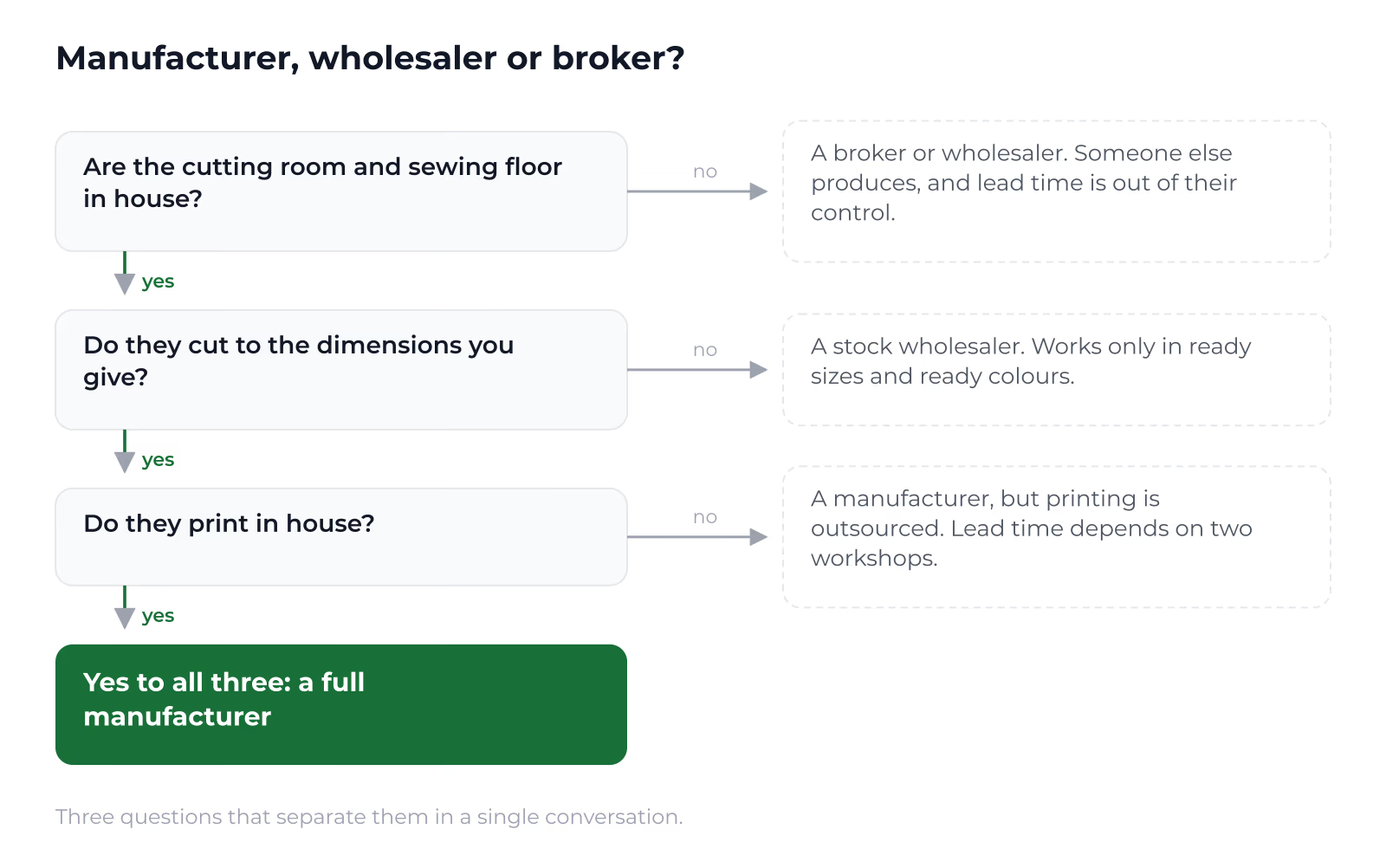
Not every company that appears in your search results is a manufacturer. Telling them apart in the first conversation makes every later step easier.
| Type | What they do | Advantage | Risk |
|---|---|---|---|
| Manufacturer (factory) | Buys fabric, cuts, sews, prints or manages printing | Price, lead time and quality in one place | May be inflexible on very small runs |
| Contract sewer | Sewing only, fabric and print are yours | Low sewing cost | Fabric and print risk stays with you |
| Wholesaler | Sells finished stock, printing usually outsourced | Fast delivery | Limited to stock models and colours |
| Broker | Takes the order, has it made elsewhere | Many products from one contact | Responsibility scatters when something goes wrong |
The fastest way to tell them apart is a single question: "Are the cutting room and sewing floor yours, and may I see the production address?" A manufacturer answers with an address and an appointment. That is why the Duru Çanta production tour is documented openly.
Twelve questions to ask before ordering
1. What is your monthly production capacity?
If the answer is "unlimited", do not trust it. A real workshop states capacity in machines and shifts. If your order exceeds a third of that monthly capacity, your delivery date carries risk.
2. How long does a sample of this model take?
Sample lead time predicts production discipline. Two to four working days for a standard model and five to seven for a custom pattern are reasonable. A supplier who will not commit to a sample date will not commit to a production date either.
3. Do you state fabric weight in writing?
In a cotton bag, weight is everything. "Thick fabric" is not a measurement. The quotation must carry a number in grams per square metre. Raw cotton typically runs 120 to 220 g, canvas 240 to 320 g and gabardine 200 to 260 g. The differences between materials are laid out in our fabric selection guide.
4. What is your fabric width, and is cutting waste included in the price?
When the bag dimension does not match the roll width, waste climbs from five to fifteen per cent and lands in your price. A manufacturer who can drop waste by changing a dimension by one centimetre is saving you money. We explain that calculation in the cost breakdown.
5. Do you print in house?
If printing is outsourced, your lead time now depends on two workshops. Colour problems also become a shared responsibility. Print and fabric compatibility is a separate topic, covered in our printing techniques guide.
6. How do you confirm colour?
A serious manufacturer asks for a Pantone reference and sends a colour proof before production. "We will match the image" is a sign of an argument waiting to happen after delivery.
7. What do you commit to on wash durability?
A promotional bag is not used once and discarded, it ends up in a wardrobe. Ask how many washes the print survives. A company that cannot answer has probably never run the test.
8. Can dimensions change after ordering, and until when?
Once cutting starts, dimensions are fixed. A manufacturer who says so upfront is protecting you. One who says "of course we can change it" is either late starting production or planning to invoice the difference later.
9. At what quantities does the price step down?
Quantity breaks reveal a supplier's cost structure. A company that states them clearly knows its own costs. Typical break points sit around 500, 1,000, 3,000 and 5,000 units.
10. What is your delivery date based on?
The right answer is not a single date but a conditional schedule: so many working days after sample approval, fewer if the fabric is in stock. A supplier who gives an unconditional date usually misses it.
11. Who covers packing and freight?
If carton count, units per carton and freight responsibility are missing from the quotation, the cost is incomplete. Carton volume matters greatly on foldable models; that calculation sits in our foldable bag guide.
12. What have you produced before?
Ask for reference work, not a reference list. A photograph of a finished bag, a close up of the stitching and one of the print say more than ten pages of company presentation. Duru Çanta publishes reference work product by product for that reason.
How to assess the sample
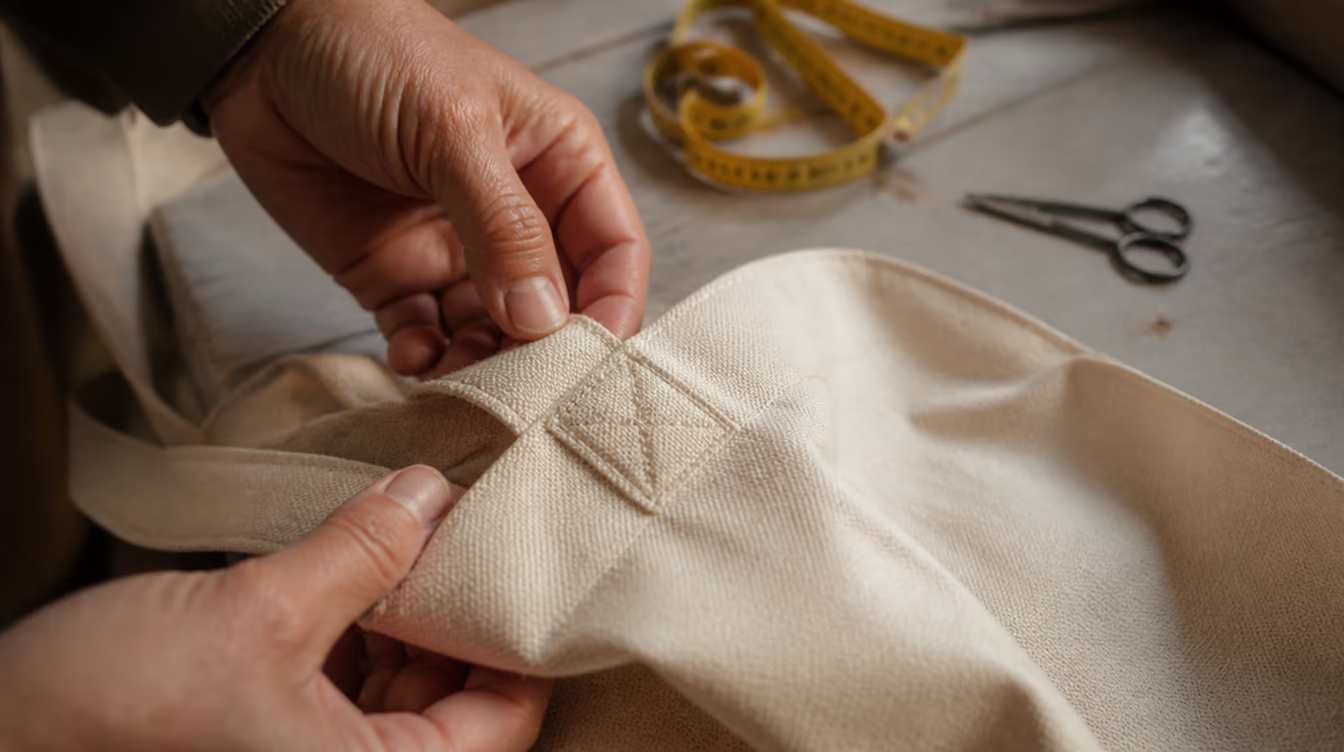
When a sample arrives, most buyers only look at how it looks. A sample is a small rehearsal of mass production and it can be read in six places.
Stitch density
Ten to twelve stitches over three centimetres is the accepted standard. Looser stitching speeds production up and invites the handle to tear away from the body.
Handle attachment
Where the handle meets the body is the failure point of any tote. Without box stitching or cross reinforcement, that is the first joint to give under ten kilos.
Edge finish
Cut edges should be overlocked or folded. An open edge frays in the first wash.
Print edge
Press a fingernail against the edge of the print. Lifting or cracking here becomes a batch wide problem in production.
Fabric hand
Hold the fabric up to the light. The evenness of the weave and how much light passes through tell you whether the real weight matches the number in the quotation.
Dimension check
Measure the sample. A one centimetre deviation can become two in production, which matters if the bag has to hold a specific insert.
What a complete quotation contains
An incomplete quotation is a preview of a later cost surprise. All of the following should be in writing.
| Line | Why it matters |
|---|---|
| Fabric type and weight | The only measurable indicator of quality |
| Dimensions (width x height x gusset) | Waste and fit for purpose |
| Handle type and length | Shoulder or hand carry decides the use case |
| Print technique, colour count, print area size | The most volatile cost line |
| Quantity and price breaks | Lets you optimise the order size |
| Sample and production lead times | Your campaign calendar depends on it |
| Units per carton and carton size | Freight and storage cost |
| Payment terms | Deposit share and balance timing |
Warning signs
- Free and unlimited samples. A sample costs money. A company giving unlimited free samples recovers that money somewhere else.
- A price clearly below the market. Roughly half the cost of a cotton bag is fabric. A very low price comes from low fabric weight and shows up on delivery.
- No clear production address. A company that gives only an office address makes its bags somewhere else.
- Numbers by message instead of a written quotation. Nothing unwritten can be defended later.
- The subject changes when you ask about lead time. Avoiding delivery dates is the most common symptom of a capacity problem.
What changes between small and large orders
A 500 unit campaign and a 20,000 unit export order are not judged by the same criteria.
Between 500 and 2,000 units speed and flexibility matter most. A manufacturer who can work from stock fabric, turn a sample around quickly and keep small run pricing sensible is the right choice.
Above 5,000 units the criteria shift: fabric supply chain, dye consistency within one batch, carton standardisation and a commitment in case of delay. At this scale an in house cutting room stops being a preference and becomes a requirement.
What belongs in the order confirmation
An order confirmation is a contract. Without these four clauses you have nothing to point to if there is a dispute:
- That the approved sample is the reference and production will be judged against it.
- The acceptable dimensional tolerance, usually plus or minus one centimetre.
- The route for colour deviation, meaning the Pantone reference and the accepted tolerance.
- What happens in the event of a delay.
What to look at during a factory visit
If you can see the production site, half an hour tells you more than ten calls. The places to look are specific.
Cutting room
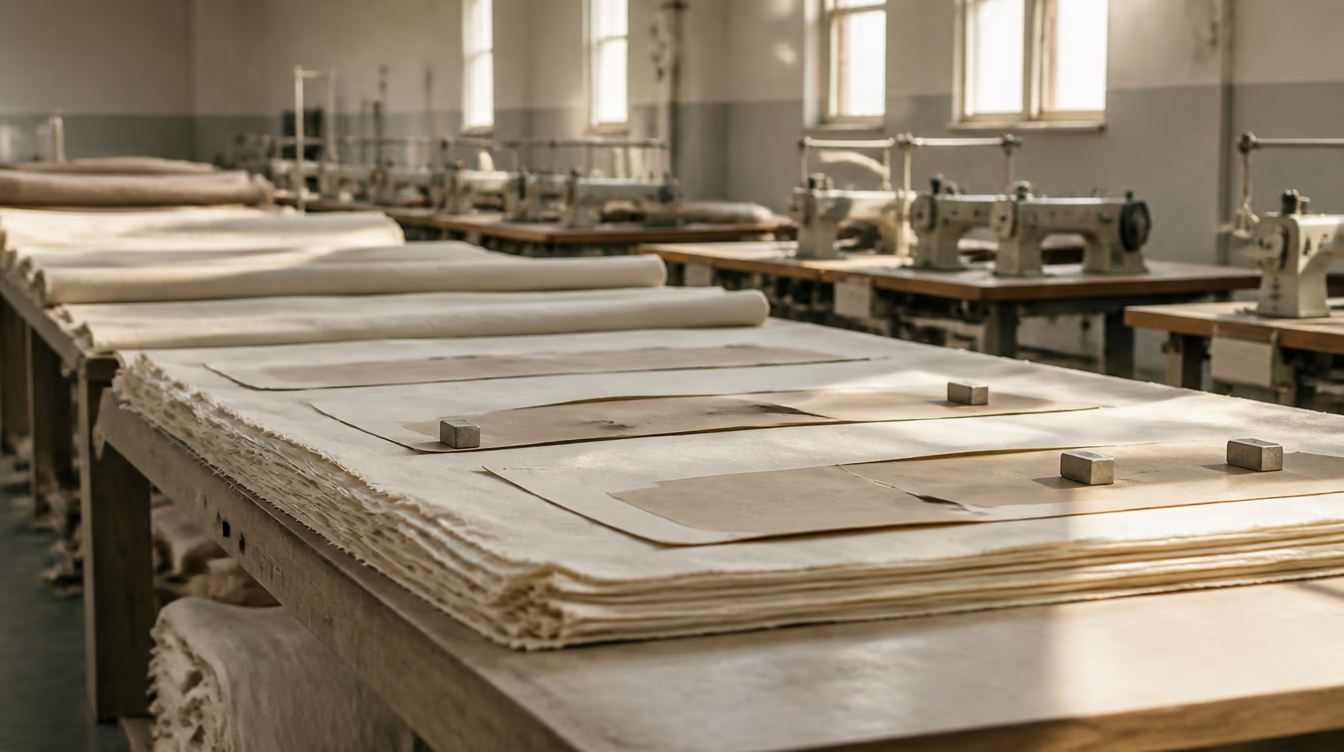
Table length, lay height and how patterns are stored show real capacity. Labelled, ordered patterns mean the same model can be reproduced. Patterns lying loose on the floor mean cutting is redrawn each time, which is a consistency risk.
Sewing floor layout
Machine count matters less than whether the machines are arranged as a line. A line layout produces consistent output at volume. A scattered layout means each order is organised from scratch and lead times become hard to predict.
Inspection point
There should be a checking table between sewing and packing. If it is missing, defective units are not being sorted out and that job has been passed to you.
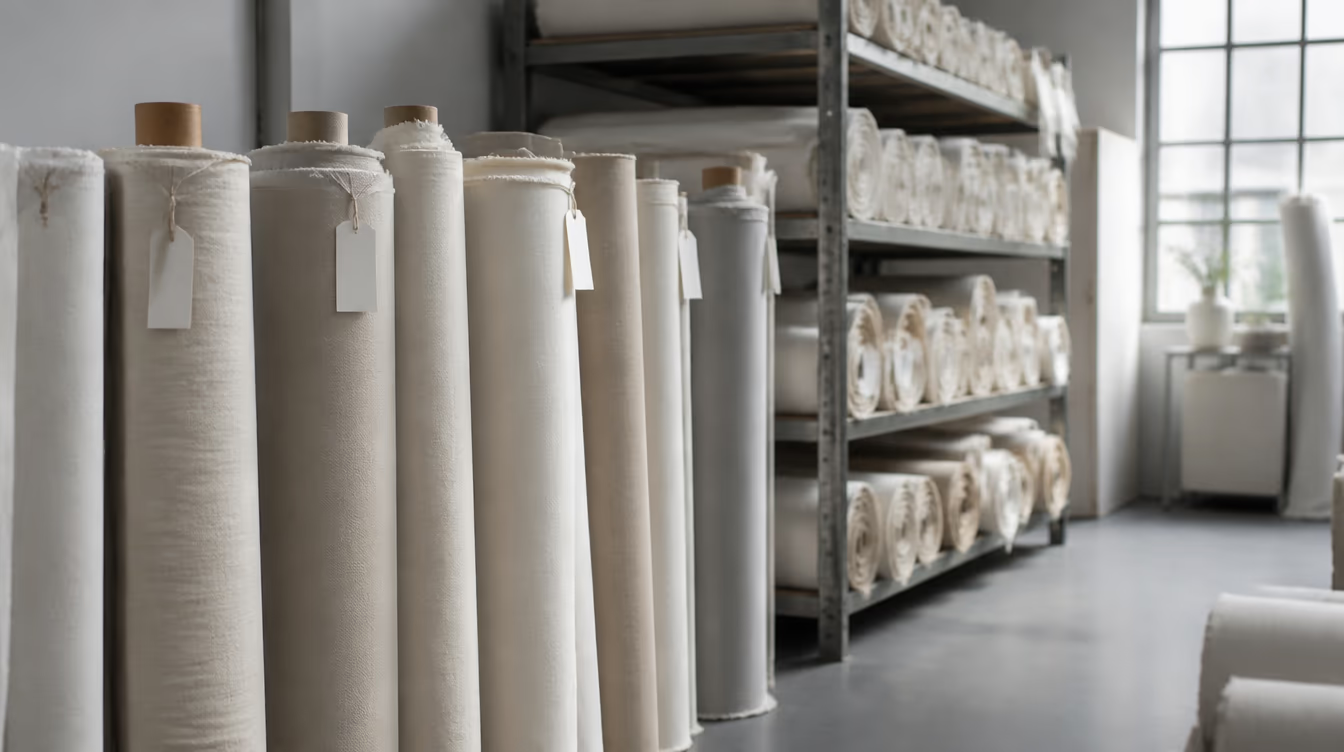
Fabric store
Rolls should be labelled, batch numbered and protected from damp. When one colour arrives from different batches, tone differences appear. An orderly store reduces that risk.
Print department
Screens, a curing tunnel and an ink cabinet under the same roof confirm that printing genuinely happens in house. If all you see is a heat press, the company does transfer, not screen printing.
What you should share in the first conversation
A sound quotation starts with sound information. If any of these six items is missing, the supplier prices on assumptions and a difference appears later.
- Purpose: trade show giveaway, retail carrier or corporate gift. That one sentence decides fabric and weight.
- Quantity: if the exact figure is unknown, give a lower and upper bound and you will see the break points.
- Dimensions: the measurements of a sample you have, or what has to fit inside.
- Artwork: a vector file and a colour reference. Without both, the print line is guesswork.
- Deadline: not the campaign date but the date the goods must be in your hands.
- Delivery address: one location or several branches. Distribution cost changes accordingly.
Frequently asked questions
How do I tell a manufacturer from a wholesaler?
Ask about the production address and the cutting room. A manufacturer offers an appointment, a wholesaler steers the conversation back to the product catalogue. The second test is custom sizing: a wholesaler works only in stock dimensions, a manufacturer cuts to yours.
Why is there a recommended order quantity?
Pattern making, screen preparation and machine setup are fixed costs divided across the run. That is why a unit price at 100 pieces can approach twice the price at 1,000. To see the steps for your own quantity, send it through the online quote form.
Should samples be paid for?
Most manufacturers cover the sample on a standard model. Charging for a sample that needs a custom pattern, custom fabric or custom print is normal, and it is usually credited against the order.
How long does production take?
Ten to fifteen working days after sample approval is typical for a standard model, and twenty to thirty for custom patterns and fabrics. Urgent requirements run on a separate line; see the express delivery models.
What should I watch when producing abroad?
Agree the certificate of origin, the fabric certification and the inspection step between sample and bulk at the very start. The most common problem in overseas orders is not quality but customs paperwork delay.
How can I bring the price down?
Three lines move the price directly: print colour count, fabric weight and dimensions. Adjusting a dimension by one centimetre to suit the roll width usually saves money without giving up fabric weight.
Scorecard
At the end of the conversation, count how many of these you received a clear answer to. Below eight, evaluate another supplier as well.
- Production address and cutting room confirmed
- Fabric weight given as a number
- Sample lead time given as days
- In house printing clarified
- Colour approval to be done on Pantone
- Quantity breaks shared
- Lead time given as a conditional schedule
- Units per carton and freight responsibility written down
- Photograph of reference work shown
- Dimensional tolerance discussed
- Payment terms agreed
- A single point of contact named for the order
Duru Çanta has worked with its own cutting and sewing floors since 2002. If you would like written answers to all twelve questions above, review the process on our cotton bag production page and get in touch with your own dimensions and quantity.